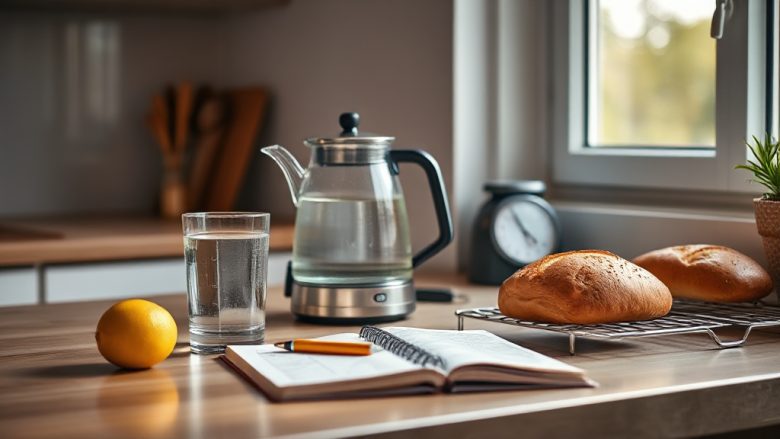
You’re standing in the kitchen, waiting for the kettle to boil, and you notice that pale, chalky crust around the base of the spout. Where does it come from? Later, you pull a loaf of bread out of the oven and wonder why it puffed up instead of staying flat. These small questions are science knocking on your door. You don’t need a lab coat or a degree to answer them. What you need is a handful of habits that turn ordinary curiosity into something you can actually test. Here are five everyday science tips for beginners that you can start using before your next cup of tea goes cold.
None of them require special equipment. None of them take more than a few minutes. The point isn’t to become a scientist. The point is to stop letting the interesting stuff slide past you unnoticed.
1. Ask “What Would Change My Mind?” Before You Decide
Most of us form an opinion first and look for reasons later. It’s a natural shortcut, but it’s a terrible way to figure out what’s true. The fix is simple: before you commit to a belief, ask yourself what evidence would prove you wrong.
Say your houseplant is drooping. Your first instinct might be “it needs more water.” Before you grab the watering can, ask what would change your mind. If the soil is already damp, more water won’t help. If the leaves are yellow and mushy rather than crisp and brown, that points somewhere else entirely. Just naming the opposite outcome forces you to look at the plant instead of your assumption.
This habit costs nothing and works everywhere. Why is the Wi-Fi slow tonight? What would change your mind about it being the router? Maybe the problem is the number of devices connected, not the signal. You don’t have to run a formal experiment. You just have to leave room for being wrong, and then check.
2. Change One Thing at a Time
If you change five things at once and the result improves, you’ve learned almost nothing. You don’t know which change did the work. This is the single most common mistake beginners make, and it’s easy to avoid.
Suppose your bread keeps coming out dense. You decide to use fresher yeast, warmer water, a longer rise, and a different flour, all in the same loaf. The next loaf is better. Great — but which fix mattered? You’ll have to guess next time, and guessing gets expensive when you’re baking every weekend.
Instead, pick one variable. Use fresher yeast and change nothing else. If the loaf improves, you’ve found something real. If it doesn’t, you’ve ruled something out, which is just as useful. The same logic applies to a stubborn stain on a shirt, a squeaky door, or a recipe that never quite tastes right. One change, one result, one conclusion. It’s slower at first and much faster overall.
3. Estimate First, Then Check
Guessing an answer before you measure it is one of the most underrated everyday science tips for beginners. It trains your intuition, and it makes the real answer stick in your memory.
How long does it take to boil a litre of water? Take a guess. Thirty seconds? Five minutes? Then actually time it. You’ll probably be off, and that gap is where the learning lives. Once you’ve timed it yourself, you’ll never forget it, because you had a stake in the answer.
This works for all sorts of things. How much does a tablespoon of salt weigh? How many steps is it from your front door to the corner? How long does a phone battery last if you leave the screen on? Estimate, then check. You’re not trying to be precise. You’re trying to build a rough mental model of the world, and rough models are surprisingly powerful. People who can estimate well tend to notice when a number is wildly wrong, which is a genuinely useful skill.
4. Keep a Simple Log of What You Notice
Memory is unreliable, especially over weeks and months. You’ll swear the tomato plants did better last year, but you won’t remember what you did differently. A few lines in a notebook fixes this.
You don’t need a fancy system. A page per topic is plenty. For the kettle, note the date you descaled it and how thick the crust had gotten. For the garden, jot down when you watered and what the weather did. For the sourdough starter, write down how it smelled and how fast it rose. Three or four words per entry is enough.
The magic shows up later. After a month or two, patterns appear that you’d never have spotted in the moment. Maybe the plant does best when you water in the morning. Maybe the bread rises faster on humid days. You’re not collecting data for anyone else. You’re building a personal record that answers questions you haven’t thought to ask yet.
5. Treat Failure as Information, Not a Verdict
When something doesn’t work, the temptation is to conclude that you’re bad at it. That’s the wrong lesson. A failed attempt is a result, and results are what you came for.
Your cake sank in the middle. That’s not a personal failure; it’s a clue. Maybe the oven runs cool, or you opened the door too early, or the batter sat too long before baking. Each possibility is testable. You’ve narrowed the field, which means you’re closer than you were before you started.
Real science is mostly failure. The experiments that work are the rare ones. Beginners often quit because they expect success on the first try, then read a bad outcome as proof they shouldn’t bother. Flip that. Every flop tells you something the success would have hidden. Keep a note of what went wrong, change one thing, and try again. That loop, repeated patiently, is the whole game.
How to Keep These Habits Going
Five habits sound like a lot, so don’t try to run all of them at once. Pick the one that fits your week. If you cook often, start with changing one thing at a time. If you’re curious about your garden or your sleep or your energy bills, start with the log. The estimate-first habit is the easiest to sneak in, because you can do it while waiting for anything.
The real trick is lowering the bar. You’re not trying to publish findings. You’re trying to notice one thing you’d otherwise have walked past. A single timed kettle, a single note about the plant, a single guess checked against reality — that’s a complete session. Do it twice a week and you’ll have a dozen small discoveries by the end of the month.
Curiosity gets a bad reputation as something you either have or you don’t. In practice, it’s a muscle. The more you ask, test, and write down, the more you see. The kettle furring up stops being a chore and becomes a question with an answer. The bread rising stops being luck and becomes something you understand. That shift, from passive observer to someone who checks, is what these everyday science tips for beginners are really about. Start with one habit today. The next question is already waiting.